Combining host plant defence with targeted nutrition: key to durable control of hemi-parasitic Striga in cereals in sub-Saharan Africa?

Screenshot 2021-03-23 at 09.37.52-3bef76dd

Open Access, Research Review, New Phytologist,  https://doi.org/10.1111/nph.17271 Authors: Immaculate M. Mwangangi, Lucie Büchi, Stephan M. Haefele, Lammert Bastiaans, Steven Runo & Jonne Rodenburg In this review paper we explore the potential of improved plant nutrition to fortify the expression of plant inherent resistance and tolerance against Striga in cereals. Beyond reviewing advances in parasitic plant research, we assess relevant […]

Orobanchaceae parasite–host interactions

Untitled copy-dd492534

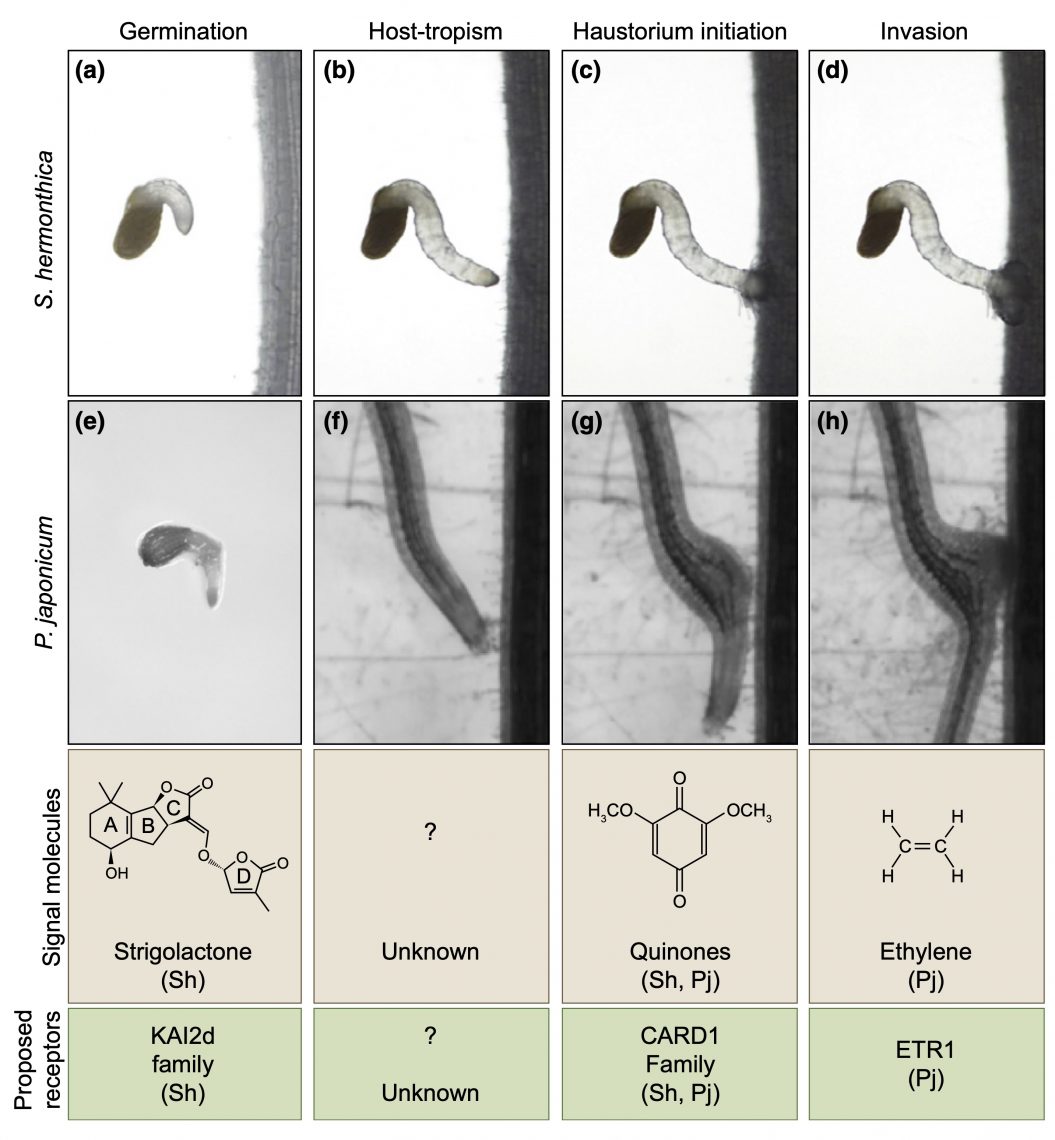
This review paper published in New Phytologist (Mutuku et al., 2021) illustrates recent progress on the molecular interaction between Orobanchaceae parasites and hosts with special focus on the processes during parasites’ germination and infection. It also highlights several genetic factors and hormones in parasitic plants important for sensing and targeting host based on the recent […]

A living bridge between two enemies: haustorium structure and evolution across parasitic plants

promo-3491631f

Parasitic plants are highly diverse in terms of their evolutionary history, life cycles, growth habits, structure, etc. Even the haustorium, which “embodies the idea of plant parasitism”, varies widely among and within parasite groups. But if we look past conspicuous differences, what can we learn about haustorium structure and evolution? Is there a common pattern […]

16th WCPP postponed to 2022

Together with the organizers, the IPPS Executive Committee has decided to postpone the 16th World Congress of Parasitic Plants (WCPP) to 2022, to be held in Nairobi, Kenya. As Covid19 case numbers continue to surge in many parts of the world, it is unlikely that pandemic-related travel restrictions will be relieved soon, preventing many members […]

Renate Wesselingh is the new IPPS treasurer

Professor Renate Wesselingh (UC Louvain, Belgium) complete the Society’s Executive Committee as the new Treasurer, voted into office with 67 %. Renate graduated as an ecologist from the University’s of Groningen (NL) and Leiden (NL) and gathered postdoc experience in Costa Rica and the USA. Since 2000, Renate is a professor in Belgium, where her work […]

IPPS Advisory Board confirmed

The members of the International Society of Parasitic Plants have confirmed the IPPS Advisory Board with great majority and voted its distinguished members Koichi Yoneyama (Ehime University, Japan), Neelima Sinha (UC Davis, USA), Julie Scholes (The University of Sheffield, UK), and Jim Westwood (Virginia Tech, USA) into office. Together, these members form an advisory body for the Executive Committee for all matters […]

From Haustorium 79: International year of plant health: Plant of the month September, Striga

Striga is a devastating parasitic weed that attacks food crops in sub-Saharan Africa such as rice, sorghum and millet. It affects 40% of Africa’s arable savanna region, and is a major cause of food insecurity and poverty. Tackling the plant health problems experienced by rural susbistence farmers requires an extra level of local collaboration and […]

Members action needed to approve the new IPPS Advisory Board

The Society asks all its members to approve the new IPPS Advisory Board. According to the majority of nominations, the IPPS Advisory Board should consist of four of its distinguished members: Koichi Yoneyama (Ehime University, Japan), Neelima Sinha (UC Davis, USA), Julie Scholes (The University of Sheffield, UK), and Jim Westwood (Virginia Tech, USA). In […]

Election for IPPS Treasurer

The International Parasitic Plant Society asks all its member to vote a new IPPS treasurer. Three candidates, Professor Rosemary Ahom (Nigeria), Professor Ahmed Uludag (Turkey), and Prof. Renate Wesselingh (Belgium) put themselves up for election. Their profiles are available at the Society’s new polling page in the members area. Clicking here or on any of […]