April IPPS Online Seminars on Mistletoes

Mistletoes: keystone species that shape ecosystems and excel at water transpiration and stomatal conductance! The April IPPS mistletoe seminar featured two insightful talks from Francisco Forturbel and Xian-Yan Huang, who kindly stepped in for Yun-Bing Zhang. Check out their recent papers to follow up on their talks: Olivares GS, et al. 2025. and Zhang YB […]

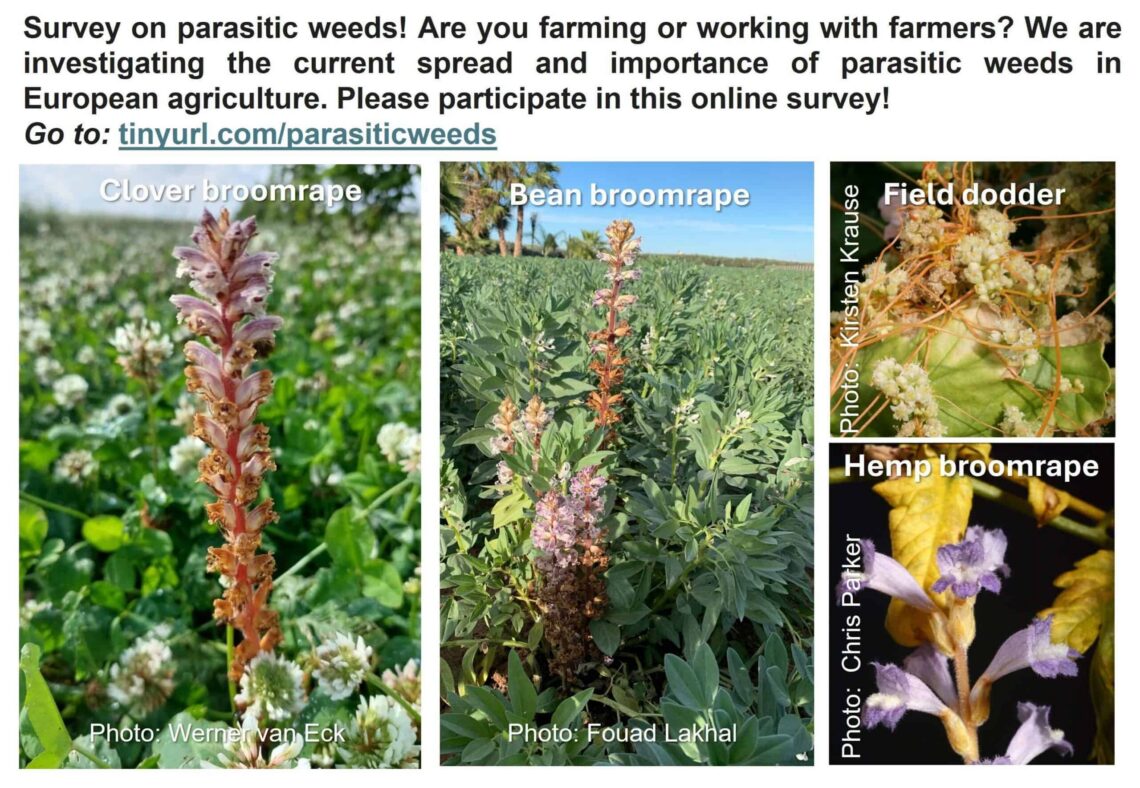
Can we expect increasing parasitic weed infestations in European arable farms?

QR-code+photos-compressed

Weeds are a major challenge in arable farming, vegetable, and fruit production. With increasing restrictions on herbicide use, effective weed management is becoming more difficult. The transition to more sustainable farming and climate change may also introduce new weed problems. An example of such new problems concerns parasitic weeds. It entails plant species that depend […]

IPPS Online Seminar on April 2nd, 2025, by Francisco Fontúrbel and Yun-Bing Zhang

First talk: Dr. Francisco Fontúrbel from the Pontificia Universidad Catolica de Valparaiso in Chile will talk about: “Mistletoe-driven facilitation at the limit of life in Patagonia” Second talk: Dr. Yun-Bing Zhang, Xishuangbanna Tropical Botanical Garden, Chinese Academy of Sciences, will talk about “Survival secrets of mistletoes: high drought tolerance in aerial habitats” Date: Wednesday, April […]

Striga hermonthica induces lignin deposition at the root tip to facilitate prehaustorium formation and obligate parasitism

CoverImage_300dpi_3 copy

Parasitic plants initiate haustorium formation—a critical step in parasitism and nutrient acquisition—by recognizing haustorium inducing factors (HIFs) from their hosts. However, the mechanisms by which these plants sense and transduce host-derived signals during early development remain poorly understood. Previous research has identified lignin monomers and their precursors, notably G- and S-type monolignols produced during lignin […]

March IPPS Seminars by Begoña Pérez Vich and Amal Boukteb

For our IPPS March Online Seminar, we had again two wonderful talks and a strong turnout from our IPPS community. Dr. Begoña Pérez Vich presented her research on the sunflower-Orobanche cumana interaction. If you’re interested in the mapping of Avirulence genes, please check out her recent publication in BMC Plant Biology (Calderón-González Á et al., […]

A long-distance inhibitory system regulates haustoria numbers in parasitic plants

Screenshot 2025-03-05 at 10.33.14

The ability of parasitic plants to withdraw nutrients from their hosts depends on the formation of an infective structure known as the haustorium. How parasites regulate their haustoria numbers is poorly understood, and here, we uncovered that existing haustoria in the facultative parasitic plants Phtheirospermum japonicum and Parentucellia viscosa suppressed the formation of new haustoria located on distant roots. […]

Forest type shapes marsupial behavior and mistletoe genetics in Southern temperate rainforests

cover_image

A recent study by Gabriela S. Olivares et al., conducted in the southern South American temperate rainforests, revealed how habitat structure influences the behavior of the arboreal marsupial Dromiciops bozinovici and the genetic diversity of two mistletoe species (Tristerix corymbosus and Desmaria mutabilis). Using camera traps and DNA sequencing, we found that D. bozinovici visits T. corymbosus more frequently in evergreen forests and D. […]

Update of the IPPS history page

Thanks to requests from our community after Jim Westwood’s IPPS in January, Jim generously offered to share his incredible collection of past WCPP conference posters, meeting photos, and some fascinating insights into the early days of the IPPS he presented in his seminar. You can now find these pictures in the updated society history section […]

Three generations of IPPS presidents meet in Senegal for Promise II meeting

Three generations of IPPS presidents, Julie Scholes, Harro Bouwmeester, and current president, Jonne Rodenburg, met recently in Senegal for the Promise II project meeting. Promise II, Promoting Root Microbes for Integrated Striga Eradication, is a Gates Foundation funded project aiming to engineer soil and plant microbiomes to enhance crop productivity in Sub-Saharan Africa. Specifically, to […]