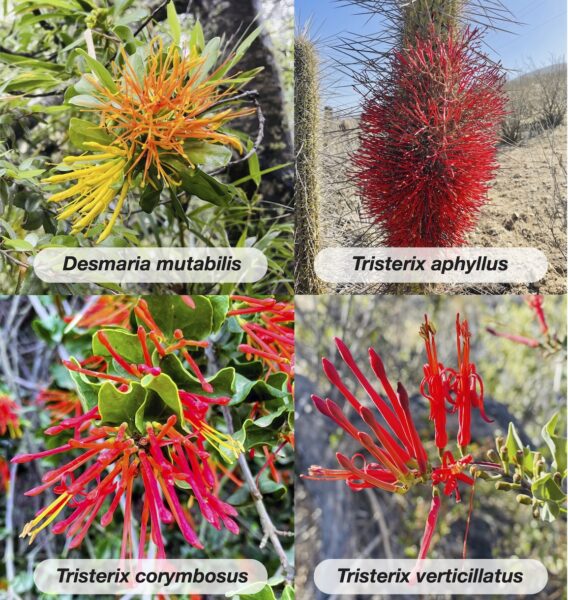

Mistletoes depend on animals to pollinate their flowers and disperse their seeds, which makes them a great system to ask how pollinators shape floral evolution. We compared the flowers of four mistletoes from southern South America (Tristerix aphyllus, T. corymbosus, T. verticillatus, and Desmaria mutabilis), whose lineages split at three different moments, from the Eocene to the Pleistocene. After measuring five floral traits in 78 individuals, we found that floral differences were ordered by divergence time: the oldest split, between the two genera, produced the biggest differences. Desmaria mutabilis, which flowers in summer and receives far more insect than hummingbird visits, was the most distinct species.
The surprise came from the youngest pair. Tristerix aphyllus and T. corymbosus separated only about 1.3 million years ago and have taken radically different ecological paths: one is a leafless parasite specialized on cacti in the semi-arid north, while the other is a generalist that grows on more than 30 host species, from Mediterranean scrub to temperate forests. Yet their flowers are nearly indistinguishable. Both are pollinated by the same hummingbird, the Green-backed Firecrown, which may be keeping their flowers in place through stabilizing selection. With only four species sampled at two sites, we cannot fully separate divergence time from other differences that accumulate alongside it, but our results show that a shared pollinator can preserve floral form even when everything else about a species changes.
You can read the full article here: https://doi.org/10.1093/aob/mcag317