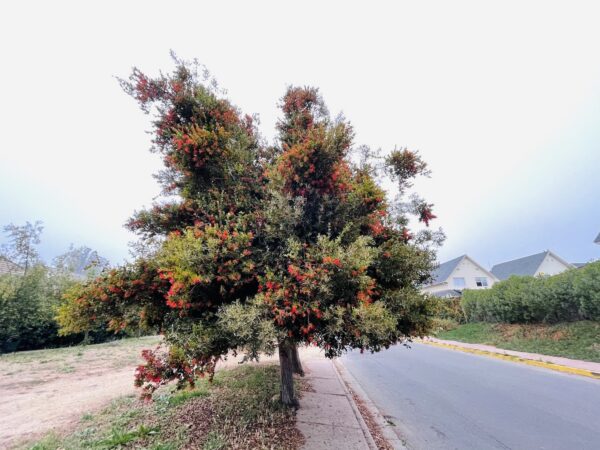

In the city of Valparaíso, central Chile, we studied how the native mistletoe Tristerix corymbosus performs on native and introduced host trees. Mistletoes are parasitic plants that take water and nutrients from their hosts, and in urban areas they are often found on fast-growing introduced trees such as Acacia. We found that introduced hosts had better water status and more water-conducting tissue than native ones, and mistletoes on fast-growing hosts, including the native pioneer shrub Aristotelia chilensis, tended to grow larger. Yet the mistletoes themselves kept a stable water status regardless of their host, suggesting that they actively regulate their own water balance.
Here’s the twist: once we accounted for plant size, mistletoes growing on native hosts produced more than twice as many fruits as those growing on introduced hosts. This points to a trade-off between growth and reproduction: a “luxury economy” of water and nutrients on fast-growing hosts seems to favor vegetative growth at the expense of fruit production. Our results also suggest that host growth strategy, rather than origin alone, is the main axis of variation, and they show how a native parasite can act as an “urban exploiter” in cities dominated by introduced trees.
You can read the full article here: https://doi.org/10.1007/s11252-026-02112-2