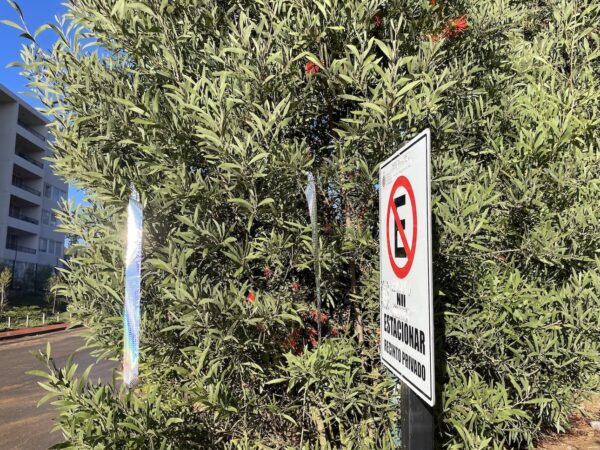

Mistletoes can weaken the trees that host them, and in cities the usual remedy, pruning, is costly, needs repeating, and can harm the tree. Because most mistletoes depend on birds to pollinate their flowers and disperse their seeds, we asked whether a cheap bird deterrent could interfere with one of those services without affecting the other. We hung reflective tapes, widely used to scare birds from crops, on urban plants of Tristerix corymbosus in central Chile and compared them with untreated plants. The tapes had no detectable effect on visits by the Green-backed Firecrown hummingbird or on fruit set; the number of flowers, not the tape, explained hummingbird visits. Frugivory, however, dropped sharply: taped plants had fewer perching events, about 80% fewer fruit consumption events, and far fewer bird droppings containing seeds.
The tapes cost roughly USD 0.19 per plant and lasted about six months before tearing, so they look like a promising low-cost, non-invasive option. There is an important caveat, though. Seeds accumulating on host branches did not decrease, since they can also arrive from fallen fruits or from birds perching on neighboring plants, and we did not measure new infections. We therefore see tapes as a complement to pruning rather than a replacement, best placed on the mistletoes with the heaviest fruit loads, which act as the main seed sources. Whether birds habituate to the tapes over longer periods remains to be tested. Along the way, we found that the Rufous-tailed Plantcutter (Phytotoma rara) was the main fruit consumer, while the Chilean Mockingbird, the disperser described in the literature, was never seen eating fruit.
You can read the full article here: https://doi.org/10.1016/j.tfp.2026.101531