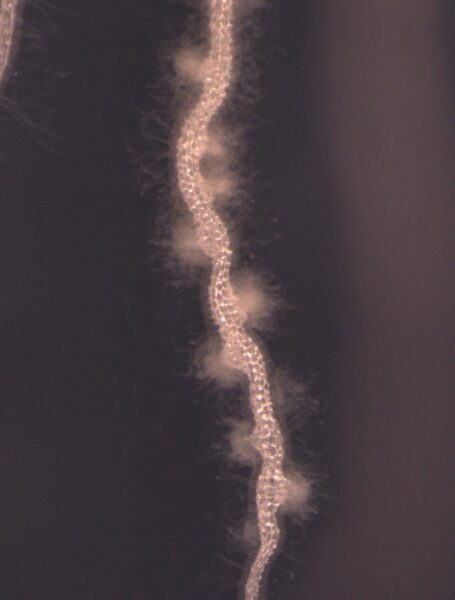

Parasitic plants initiate parasitism in response to haustorium-inducing factors (HIFs). Orobanchaceae hemiparasites recognise lignin-derived quinones and phenolic HIFs. Since lignin is widely conserved among vascular plants, including parasitic species, it was a mystery for a long time why parasitic plants do not form haustoria on their own or on closely-related parasitic species.
We identified a Phtheirospermum japonicum mutant, named spontaneous prehaustorium (spoh1), which forms prehaustoria on its own roots without any external signal. Genetic analysis revealed that this phenotype results from a mutation in a single gene, PjUGT72B1, which encodes a glucosyltransferase enzyme. Cloning, heterologous expression and mutant analysis showed that PjUGT72B1 glucosylates HIFs and inactivate their haustorium-inducing activity. This suggests that parasitic plants inactivate their own HIFs thus avoiding self-haustorium formation. Intriguingly, the host Arabidopsis UGT72B1 also suppresses HIF activity, but has a more restricted substrate specificity than the parasite enzyme. Our results show that the glucosylation of HIFs is an important factor in the modulation of the host-parasite interaction. This finding opens up new avenues for the control of parasitic weeds.
Xiang L, Cui S, Saucet SB, Takahashi M, Inaba S, Xie B, Schilder M, Shimada S, Cui M, Li Y, Watanabe M, Tobimatsu Y, Bouwmeester HJ, Tohge T, Shirasu K, Yoshida S, 2025. Glucosylation of endogenous haustorium-inducing factors underpins kin avoidance in parasitic plants. Science 390 (6771):405-410. https://www.science.org/doi/10.1126/science.adx8220